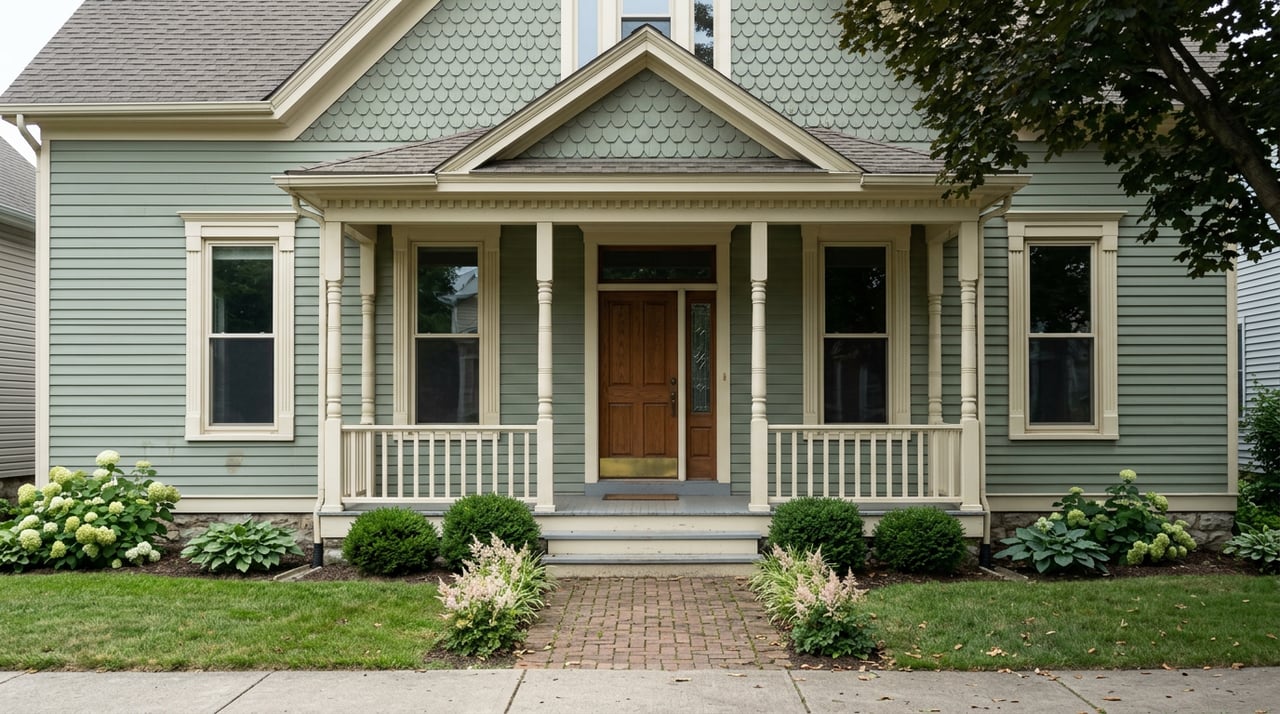
The Approval You Need Before You Touch a Heritage Hill Home's Exterior
August 27, 2026
August 27, 2026
In 2023, a house on Lafayette Avenue SE got jacked up off its foundation, rolled onto dollies, and moved down the street. The 1905 Shingle-style home, built for Ira M. Smith and later used as a meeting hall for the North Star Masonic Lodge, wasn't condemned or crumbling. It was in the way of a new development, six parcels between Lafayette and Prospect Avenues where Grand Rapids firms Indigo Design + Development and SDR Ventures LLC were planning the Townhomes of Heritage Hill. Rather than demolish a contributing structure in a National Register district, the developers moved it, a job handled by the family-owned Rollaway Movers. Before any of that could happen, both the Grand Rapids Historic Preservation Commission and the city commission had to approve the plan.
If moving a house four hundred feet requires two layers of public sign-off, it's worth asking what the district requires before you swap a storm window. The answer is the same process, just smaller in scale, and it's the detail that trips up buyers who assume the historic designation is a description of the neighborhood rather than a regulatory switch that flips the moment they close.
Heritage Hill is one of six local historic districts in Grand Rapids, but it's the largest by a wide margin. The neighborhood holds roughly 1,300 buildings dating back to 1843, spread across a full square mile just east of downtown, and it's recognized as a National, State, and Local Historic District. More than 4,000 households call it home today, a mix of restored Victorians, converted multi-family buildings, and the occasional landmark like the Meyer May House. Architecturally, you'll find Greek Revival sitting next to Queen Anne next to Prairie style, sometimes on the same block.
That density of protected structures is exactly why the city treats exterior work here differently than it does almost anywhere else in Kent County.
Most home buyers understand building permits. Fewer understand that in a historic district, the permit is the second step, not the first. Before the city will issue a building permit for exterior work in Heritage Hill, you need a Certificate of Appropriateness, known locally as a COA, from the Historic Preservation Commission or its staff. Skip that step and the permit office has nothing to issue.
The scope of what needs a COA is broader than most new owners expect. It's not limited to additions or major renovations. Doors, windows including storm windows, fences, yard structures, and driveway or sidewalk approaches all fall under the ordinance if the change is visible from the street. A homeowner who assumes they can simply replace failing storm windows the week after closing, the way they could in almost any other Grand Rapids neighborhood, is often surprised to learn that request needs a certificate first.
The city's own application makes the sequencing explicit: submit, get a determination on whether staff or the full commission needs to review it, then wait for that review before permits move forward.
Not every COA request follows the same timeline. The city sorts applications into two tracks:
| Review Type | Who Decides | Typical Pace |
|---|---|---|
| Staff-level | Historic Preservation Specialist | Can be resolved administratively, often within days |
| Commission-level | Full Historic Preservation Commission | Requires a public hearing at a monthly meeting |
Projects that stay close to what's already there, matching materials, in-kind repairs, minor fixes, tend to qualify for staff review. Anything larger, more visible, or more likely to alter the building's character, new construction, additions, replacing original materials with something different, gets scheduled for a commission hearing.
The gap between those two tracks is the single biggest variable in how fast a buyer can actually start work on a historic home, and it's knowable before you write an offer. The city's planning staff will give you a predetermination over the phone if you describe the project in advance. Most buyers don't think to call until after they own the house.
The Historic Preservation Commission meets the first Wednesday of each month at 5:00 p.m. at the Development Center on Monroe Avenue NW. That sounds like a predictable monthly cadence you can plan a renovation around. It isn't, quite.
Applications requiring commission review have to be filed by a deadline that falls before the meeting itself, not on the meeting date. And the city's own application materials warn that meeting agendas can fill up before that filing deadline arrives. In practice, that means the real planning window is shorter than the calendar suggests twice over: once for the filing cutoff, and again for the chance that the month you were counting on is already full by the time you submit.
For a buyer trying to line up exterior work with a purchase-to-close timeline, that's the friction that doesn't show up anywhere on a listing sheet. A 30 or 45 day closing window can put you right in the middle of a filing deadline you didn't know existed, and missing it doesn't mean a short delay. It means waiting for next month's docket, if there's still room on it.
The process isn't designed to be adversarial, and the experience of past buyers backs that up. When Paul and Merideth Kuiper bought a home more than 150 years old on Charles Avenue SE in the Cherry Hill historic district, planning to handle most of the renovation themselves, one of their first calls was to the city's historic preservation specialist, Rhonda Baker. She met them at the house to walk through what would and wouldn't be approved before they got far into planning. By Paul Kuiper's account, the commission's specific notes, things like porch spindle spacing, were details he said he "wouldn't have thought much about" on his own, but that kept the house's historic character intact.
That's the pattern worth noting: the commission's pushback tends to land on specific, fixable details rather than blocking a project outright. The Kuipers' work on that Charles Avenue home was recognized in the city's 2025 preservation awards, alongside other local projects like 800 Wealthy Street and a Heritage Hill home on Fountain Street NE. The commission isn't just a gatekeeper. It's also the body that publicly credits owners who get the details right.
A COA application carries a nominal review fee, due at submission, on top of whatever your standard building permit costs. That's a small line item compared to what buyers should actually budget for: because most Heritage Hill homes predate 1978, any work that disturbs old paint triggers lead-safe work practice requirements, which means verifying your contractor's certification before signing a contract, not after.
On the other side of the ledger, owner-occupied rehabilitation work in a historic district can qualify for Michigan's State Historic Tax Credit, a real offset for buyers planning a serious restoration rather than cosmetic updates. Whether a specific project qualifies depends on the scope of work and how it aligns with the Secretary of the Interior's Standards for Rehabilitation, the same standard the commission uses to evaluate COA applications in the first place.
The buyers who move through this process smoothly are the ones who front-load the questions instead of discovering the answers after closing:
Every one of these is a phone call or a records request, not a negotiation point, and all of them are easier to make before earnest money is on the table.
Does a COA apply to interior work? No. The ordinance governs exterior changes and repairs visible from the street. Interior renovations follow standard permitting.
Can I get a COA predetermination before I own the house? Yes. The city's historic preservation staff can tell you over the phone whether a described project would likely need staff review or a commission hearing, which is exactly the kind of due diligence worth doing during a showing, not after closing.
Does every historic-looking Grand Rapids neighborhood require a COA? No. Heritage Hill is one of six local historic districts in the city, and the requirement applies specifically to those districts and to individually designated landmarks, not to every older home citywide.
Buying in Heritage Hill means buying into a review process, not just a house, and the buyers who do well here are the ones who ask about that process before they're under contract, not after. If you're weighing a purchase in Heritage Hill, Cherry Hill, or any of Grand Rapids' historic districts, Tony Hernandez can walk you through what a specific property's exterior plans would realistically require before you write an offer. And if you're also sizing up what your current home could sell for as part of that move, start with a free home valuation.
Stay up to date on the latest real estate trends.

Get assistance in determining current property value, crafting a competitive offer, writing and negotiating a contract, and much more. Contact me today.